

Stats Saturday: Local Democracy At Work
How Participatory Budgeting leaves breadcrumbs toward a better future.

Porto Alegre is a city in the southern part of Brazil, with over 4 million residents. In 1988, Olívio Dutra, a founding member of the Workers’ Party, was elected mayor.
Porto Alegre has been home to human civilization for over 11,000 years, and was elevated to a parish in the late 1700s, emerging from beneath Spanish rule (unsurprisingly, both Portuguese and Spanish Colonialism tore the Indigenous populations asunder). In 1835, a separatist revolt (the Farraoupilha Revolution) occupied the city for nearly a year, before falling back into central control. For the next century, the city saw a massive influx of immigration from Europe, port improvements, educational and industrial growth, and cultural diversification (if one would like to call it that).
Under Castilhismo rule, the city consolidated power to create the “golden phase” of architecture and public infrastructure, while exacerbating class stratification between the haves and have-nots. Workers’ protests began in 1906, with a general strike against tumultuous working conditions. The Workers’ Party was vilified by conservative forces, but built toward the Revolution of 1930, ending the Old Republic.
By the 1960s, political division between far-left and far-right movements led to the military coup of 1964, borne out of a fear of Communism. The United States aided in the Military Brigade, which removed populist politicians from office, closed unions, barred the free press, and persecuted many UFRGS professors.
Dissatisfaction only continued to grow in the late 1960s through the 1970s, as ever-increasing military dictatorship and austerity politics took shape. Porto Alegre led a groundswell of ecological protests and faced political repression throughout the 1980s.
Enter Olívio Dutra.
With his election in 1988, the city began a process known as Participatory Budgeting (PB). Working in tandem with a variety of community groups, the mayor overhauled the city’s budget process, empowering residents to directly “propose and vote on local investment projects” (Renzio et al., 2019). Participatory Budgeting did not just increase anecdotal agency for local residents, but led to tangible improvements for working-class individuals.
Basic sanitation access jumped 23%, while city-level funding for healthcare and education increased 27%. PB strengthens the roots of democracy by enabling inclusivity of all those who live within an area, not just a select few.
Side Note: Only 23% of eligible voters in Chicago voted in the primaries this March, if you were curious.
More than 7,000 cities across the globe have implemented the PB process, which has resulted in the growth of meeting social needs, reducing infant mortality, and significantly increasing school enrollment.
But, here’s the kicker. Did you know that PB exists in 64 cities across the United States? And would you believe that it exists in over 25% of the wards here in Chicago?
Welcome to Stats Saturday. Pour a second cup of coffee and flip those flapjacks.
STAT: Every year, all 50 wards across the city of Chicago receive $1.5M in Discretionary Menu Funds. In 14 out of the 50 wards, Participatory Budgeting has been implemented to utilize said funds.
“If you could change one thing about our community that would make life better for you, what would it be?” – Alderwoman Maria Hadden
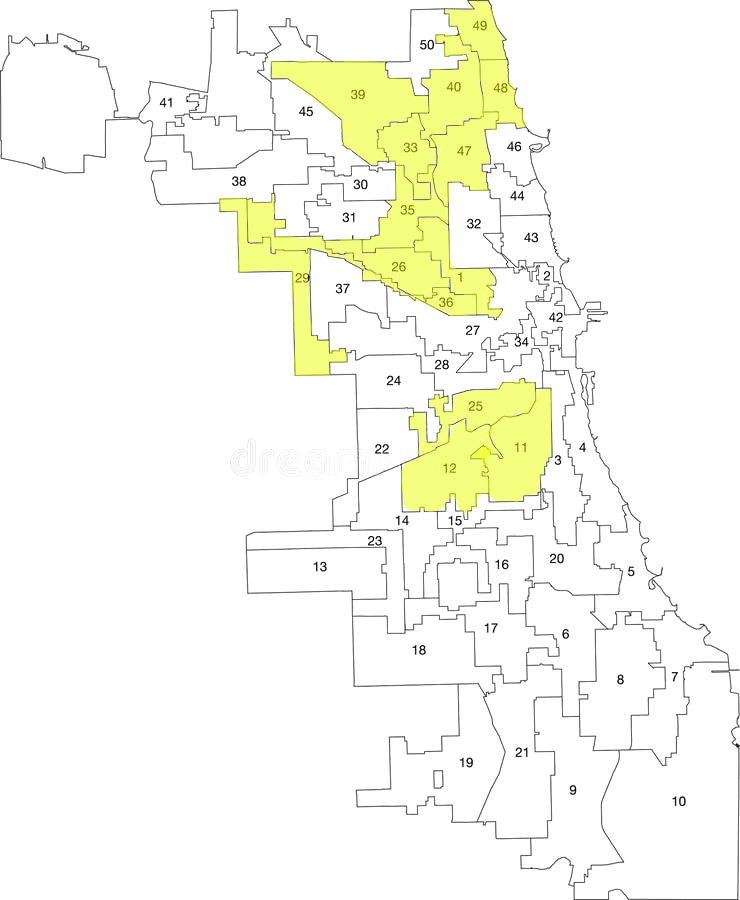
Map of Chicago wards with PB implemented into AMP funding.
The AMP has many limitations. The funding is funnelled through CDOT as a subprogram of the Neighborhood Capital Improvement Program. The improvements therefore must be tied to physical space in some capacity. It oftentimes includes spending a majority of the budget on street and sidewalk improvements, with little ability to maneuver beyond.
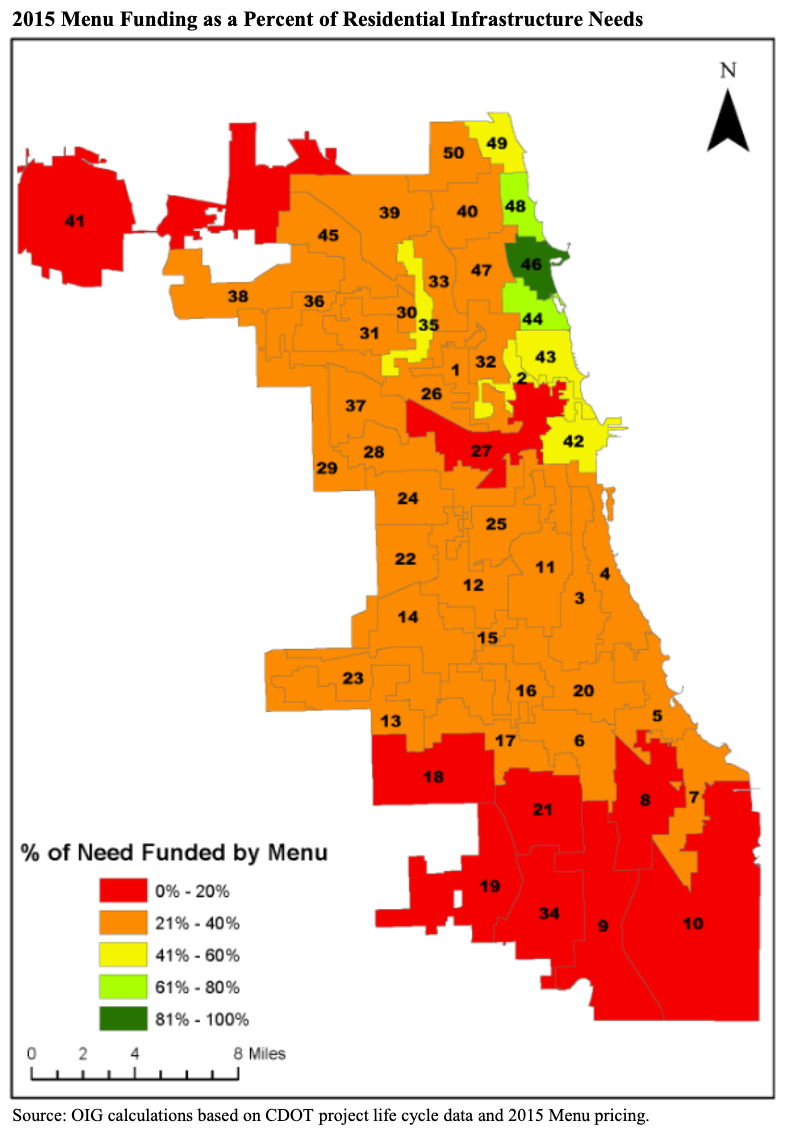
The program is simultaneously chronically underfunded and divided equally instead of equitably. An audit conducted by the Office of the Inspector General in 2017 showed that the program was short nearly $125M annually.
The map below displays the disparity in spending needs versus funding for the entire city. The map is from 2015.
However, the program has enabled space for true community control, ever-so-slightly.
In 2009, the 49th Ward introduced Participatory Budgeting into their AMP use, which was the first ward in the country to do so. PB Chicago launched in 2012, working alongside the UIC Great Cities Institute, PBP, local alders, citywide institutions, and community-based organizations.
Over the last 17 years, 13 other wards have joined the 49th Ward in implementing the PB process, each with its own flair, based on community input and infrastructural need. Attached here is a PDF chock-full of PB goodies.
The base template that is used for PB across the city is a straightforward process (both timelines and phases vary slightly from area to area):
Phase 1 - Idea Collection and Volunteer Recruitment
A number of community brainstorming sessions take place, and targeted outreach coordination works to diversify project ideation.
Phase 2 - Project Development
Oftentimes, a select PB Steering Committee will take ideas and turn them into concrete projects that are both specific and logistically feasible.
Phase 3 - Project Exposition
Residents are able to view project proposals, weigh the cost versus public good, and submit project alterations as needed.
Phase 4 - Voting
Residents (and students who attend a school within the ward boundaries) 13/14 y/o+ can vote on their favorite projects. Both online and in-person voting are typically made available.
Phase 5 - Implementation
Once project voting is done, the alder’s office will coordinate directly with CDOT to break ground on different project types.
A few great examples of AMP development through PB include:
Goethe Elementary School play space and field
Logan Square Skate Park (still in development)
West Ridge Nature Park Improvements
On the 33rd Ward’s Instagram, the latest PB votes just came in. You can check that out here.
“Wow, Brandon. This is the first time I have ever seen democracy work for working-class people at the governmental level! I would love to get involved. Where do I start?”
Is your brain breaking like mine was when I was researching this? That’s because you just realized the sham of democracy that is not so tactile was a farce!
For those of you who are interested in learning more about the PB process within your area, start by locating your alderperson via your home address. From there, I would peruse their website, send an email, or go in-person to their local office and ask for more information. I touched on this above, but residents 14 and up often are able to participate in the entire process. As long as a student attends a school within a PB ward boundary, they are likely able to partake.
In the 47th Ward, $200k is allocated for community projects, but project ideation and implementation are led by the 47th Ward Youth Council, which is filled by residents in grades 8-12.
At the end of the day, austerity politics often win because the version of government we are exposed to is opaque. Winning, populist policies (taxing the rich, healthcare and housing for all, etc.) can and would do worlds of good for the majority of Americans. However, even these policies still bifurcate the political process, ostracizing everyday people from having true agency over how their communities develop.
The PB process gives agency back to you and me. It tells us that our voice matters. Our opinions matter. Our lives matter.
“Who knows better what is needed in our ward than us?”
While this structure in its current format is heavily limited, it builds toward a more equitable and just future, with us included. And that value is truly priceless.
P.S. Clara Mattei, a Professor of Economics at the University of Tulsa, spearheads FREE, the Forum for Real Economic Emancipation. I highly encourage you to check out the work they are doing if people-led economic planning is of interest to you.
 | A guest post by
|