


Welcome to Stats Saturday! Saturday Stats. Staturday? Saturistics? You get the gist.
In a world where objective statistics become weapons of subjectivity, maybe these stat-driven pieces can serve as a kernel of hope toward some semblance of normalcy.
Social Determinants of Health are the conditions in which people are born, grow, live, and age. These determinants are shaped by the distribution of money, power, and resources, oftentimes benefiting a small percentage of those at the top of the financial chain, with negative downstream consequences.
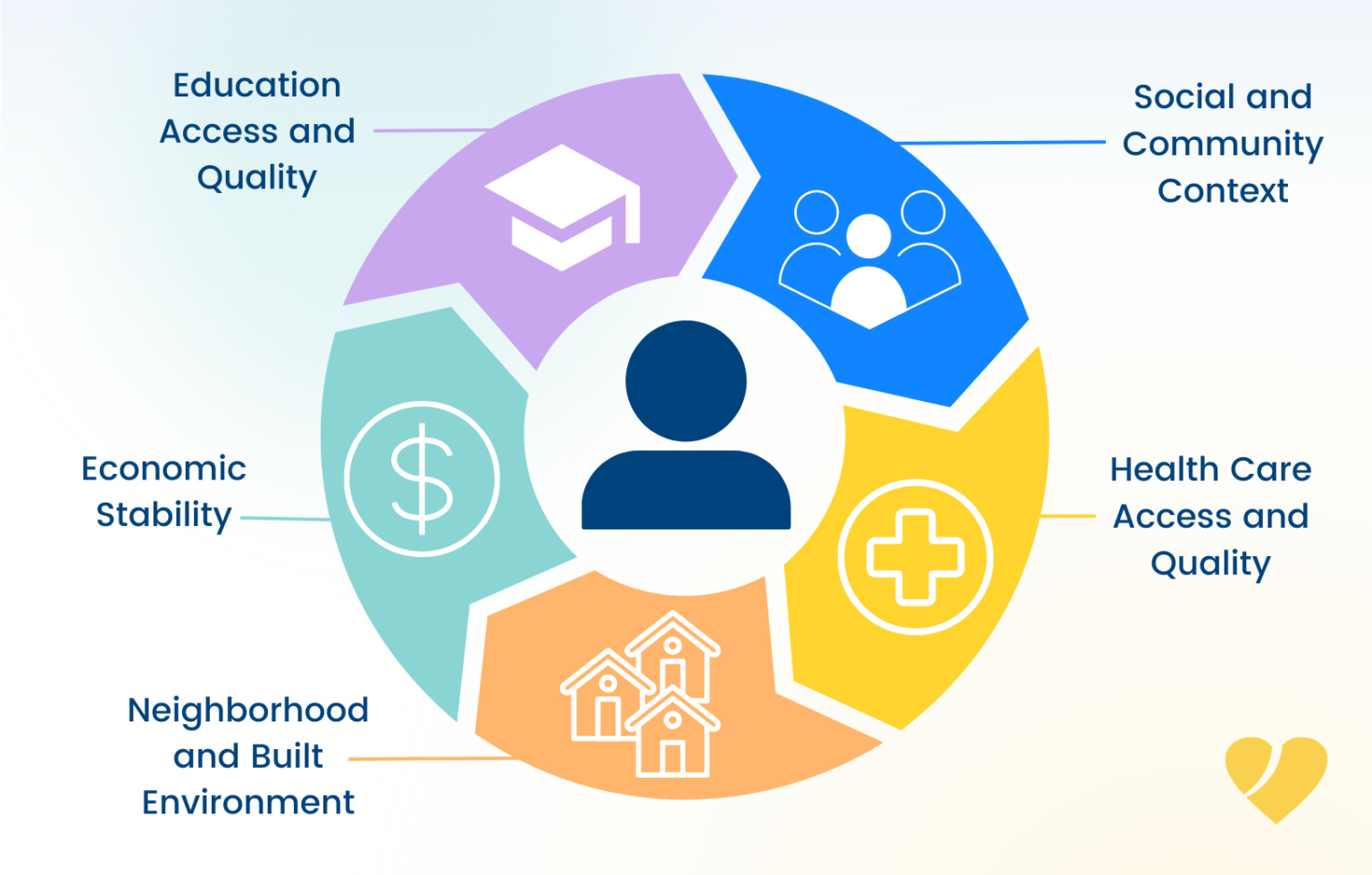
(Social Determinants of Health Visual, 2023)
An individual’s life cannot be fully interpreted without the collective nature of things such as access to resources and healthcare, community development, transportation, on top of residential segregation, language and literacy rates, and a myriad of other socioeconomic conditions.
Stats Saturday will present empirical evidence through this collective lens.
This week’s edition will focus on housing.
Keep in mind that statistics cannot and do not exist in a vacuum, nor do they paint the entirety of the picture. However, if they make you question our society’s unshakable belief in American exceptionalism ever so slightly, then my work has been done.
Take the bits that compel you. Challenge yourself with evidence that contradicts your natural instincts. And leave a Claude-created angry post in the comments if you disagree with me (don’t use AI, but call me a Bolshevik if you must, the algorithm might like that).
Without further ado, let’s look at a stat.
Stat: “Even at the 90th percentile of housing supply shock, it would take 16 years for housing to become affordable to the average full-time worker without a college education in Los Angeles and New York.”
The International Inequalities Institute (say that three times fast) released a working paper in January of this year, which disintegrates the trickle-down housing policy initiatives driven by abundance bros (we have all been Ezra Klein pilled at one point – it’s okay). To avoid getting screamed at by every YIMBY within a three-mile radius (a group in which I do belong to), I want to state on the record that there is an estimated supply shortage between 4-7 million homes in the US. The III statistic doesn’t discredit this notion, but it does question the prescriptive nature of housing shortage causing an ever-growing rise in housing costs. Neoliberal YIMBY-ism fails to observe the larger material conditions that have driven housing costs to unprecedented levels.
In 2025, the vacancy rate of rental units across the country sat somewhere between 6-8.5%, depending on single-unit vs. 5+ unit vacancy breakdowns. Vacancy rates are important for obvious reasons. It shows the immediate contradiction between the necessity of building housing while ignoring the fact that a large percentage of rental units remain unoccupied. Even when reading about the vaunted New Deal in relation to growing public housing, terms such as “disastrous” are thrown around regarding the 2.1% vacancy rate in 1937. Building new, cleaner housing to move laborers out of slumlike conditions was vital during this time period, but framing the vacancy rate through this small vantage misses the forest through the trees.
Vacancy and unemployment rates are shadows of one another. The Capitalist viewpoint (which even liberal Fed chairs abide by) constantly works to balance the national inflation and unemployment rates. The incentives are to balance the borrowing power of the average American by tinkering higher interest rates as real wages or job opportunities grow.
This same lens can be applied to low vacancy rates, being seen as “disastrous” because it indicates a slow-down in the housing development supply-chain. Neoliberal abundance-ites think that private developers are solely driven by the market’s demands for housing supply needs. I will even lift that the National Alliance to End Homelessness has stated that NO STATES have enough permanent housing for people in need.
This statement presupposes that our current housing system does not believe housing is inherently a human right. That means federal subsidies, tax reimbursement programs, and rent stabilization policies are the only way to house those without a home. With vacancy rates this high, while over 750,000 people in the US experience homelessness, the circular-logic of housing supply and demand is set in stone.
If a small minority is enabled to profit from a human right, no amount of incentivization or deregulation will alleviate our housing issues. As unemployment is to corporate moguls, vacancy is to landlords. Vacancy rates must exist to price-gouge renters, while homeowners cling to their only means of accruing wealth and long-term financial stability. Without the fear of sleeping outside, landlords would not be able to suppress tenant rights.
But what if we looked at this from the other perspective?
Collective ownership of public goods (housing, transportation, education, healthcare, occupation) would operate under the principle of “from each according to his abilities, to each according to his needs”. I will avoid veering too far into my own ideological belief set, but the ‘build baby build’ nature of supply-side shocks is infuriating. Over 10% of housing units in the State of New York are unoccupied, yet over 158k folks are homeless at the moment of my writing. Private ownership will never solve the contradiction of those who do and do not get to sleep with a roof over their heads.
The working paper disproves the notion that unfettered building of housing would magically solve housing shortages. Wage stagnation, private ownership, and lack of communal spaces are all significantly larger factors contributing to our current housing issues. Recently, I talked to a friend whose rent is going up $100/month, and it just-so-happens to coincide with a new housing development breaking ground across the street from him. Even I am being priced out of my neighborhood despite a laundry list of new housing developments being promised on my alderperson’s website.
Crazy take incoming: What if we prioritized getting people in the housing structures that currently exist before assuming that infinite growth will lead us to the promised land?
Mind blown?
A society not oriented around one’s needs but instead reliant on subservience to profit margins will never solve the inherent contradictions until redistribution of power occurs. Both finances and capitalism are self-constructed societal apparatus that require populist buy-in for minority benefit.
As contradictions bleed people dry, revolutionary attitudes and class consciousness will continue to take shape.
But let’s start by putting people in some damn homes.

