

The Gig Economy Came For The Block And Called It Liberation
tl;dr | The app-based gig economy is less "be your own boss" and more "congratulations, you played yourself"

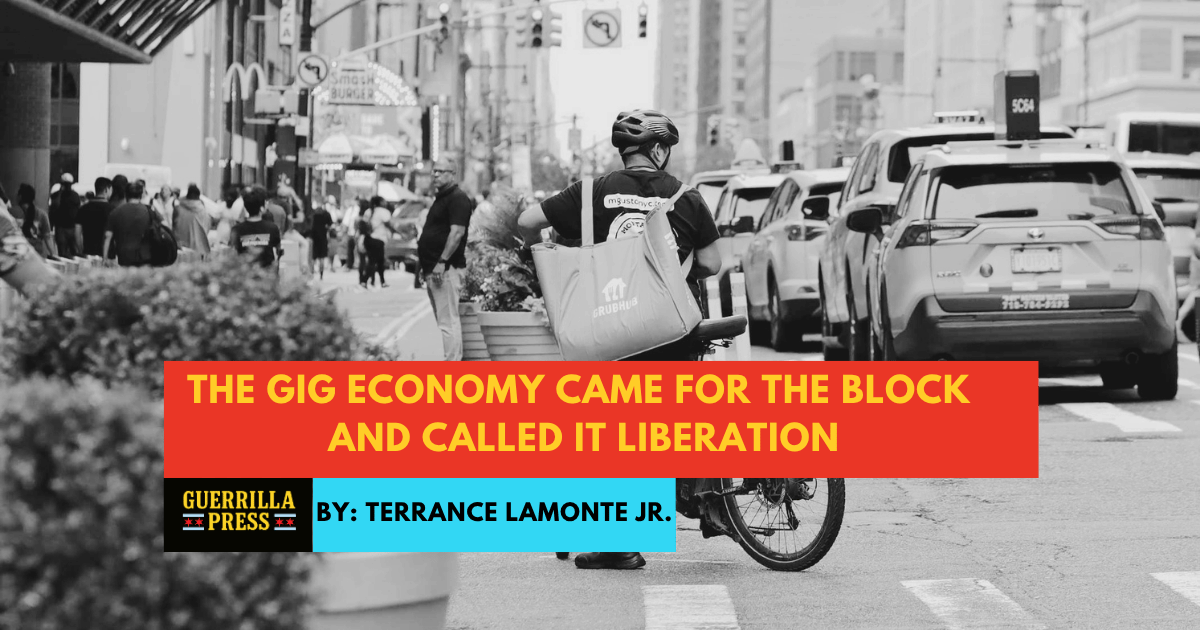
Congratulations, You’re the CEO of Being Used
The gig economy arrived on the West Side in a 2011 Nissan with a check engine light and a “You’re the Boss” notification. Apps like Uber, Lyft, DoorDash, Instacart, and Amazon Flex promised freedom: set your own hours, be your own manager, and earn unlimited money from the comfort of your car.
However, the “boss” part of the gig economy comes with anxiety, a broken-down car, and sometimes speeding away from Boyfriend Bullets. The “big boss” with health insurance and stock options lives in San Francisco and calls themselves a “founder.” Gig platforms misclassify workers as independent contractors, thereby avoiding basic labor protections such as minimum wage, overtime, unemployment insurance, and health care, while controlling pay rates, job assignments, and discipline through algorithms.
In Illinois, app-based gig work has exploded, with Cook County having the largest share of such work in struggling neighborhoods. For many, gig work is the only way to make ends meet, making the “work when you want” feel like a Teen Takeover-style snap curfew imposed by an app notification.
This guide briefly explains how the gig economy works, and offers practical, community-centered responses beyond just “tipping drivers more”. Let’s go!
Step 1: Recognize When “Be Your Own Boss” Means “Exploitation”
Just like The Wizard in Wicked, the central magic trick of the gig economy is all in the label: companies call workers “partners” or “independent contractors” to dodge labor protections while treating them like employees who can be fired by an algorithm at any moment. Real independent contractors negotiate their rates, set terms, and choose clients; gig workers get preset pay, non-negotiable terms of service, and the constant threat of unexplained deactivation if ratings dip, prompting the algorithm to say "Sashay Away."
A major human rights report on US gig platforms describes how companies like Uber, Lyft, DoorDash, Instacart, Amazon Flex, and others unilaterally set pay rates, control access to work, and rely on opaque, ever-changing algorithms that keep workers in the dark about how their pay is calculated. Many workers end up earning less than the local minimum wage after accounting for unpaid waiting time and expenses like gas, insurance, and vehicle maintenance.
In Illinois, community listening sessions with gig workers reveal patterns of juggling multiple platforms, working irregular hours, and taking on everything from food delivery and ride-share to freelance marketing and convention work just to patch together an income. Many workers report health and safety challenges, from traffic accidents and assaults to stress-related issues, all without paid sick time, workers’ compensation, or employer-sponsored health insurance.
Step 2: Follow the Money (Spoiler: It Is Not in Your Bank Account)
If this system is supposedly about empowering workers, someone should probably explain why the main thing empowered is corporate valuation. Data analyses of gig platforms show wide variation in hourly earnings; one recent report estimated that ride-hail drivers for apps like Uber averaged roughly the low twenties per hour while actively on trips, while food delivery workers for DoorDash earned around eleven dollars per hour on average — the lowest among the apps studied. Those numbers do not fully account for unpaid time between gigs, vehicle costs, or the fact that many workers report effective hourly pay below minimum wage when all expenses are included.
On the corporate side, these companies have built billion-dollar businesses by externalizing basic operating costs, such as fuel, equipment, and safety, onto workers, while presenting themselves as neutral “platforms” that simply connect people. The platforms keep a significant cut of each fare or delivery fee, add service and mystery fees to customers, and quietly adjust pay formulas behind the scenes (my least favorite BTS).
So when you see an ad saying, “Work when you want! No boss!” mentally translate it to: “Work whenever the algorithm decides you are worthy of a $3.25 delivery 10 miles away, and your boss is invisible but somehow still micromanaging you from the cloud.”
Step 3: Building Something Better Than “Hustle ‘til You Collapse”
If the gig economy is a trap, the exit is not individual genius; it is collective power. Worker-organizing efforts across the country are pushing for minimum pay standards, due process for deactivation, safety protections, and the right to form unions or similar collective bodies to negotiate with platforms.
On the community level, advocates on Chicago’s southeast side and beyond have highlighted worker cooperatives as one way to keep wealth and decision-making rooted in neighborhoods rather than siphoned off by distant investors. Co-ops have been shown to create more stable, equitable jobs and expand ownership opportunities for women, immigrants, and workers of color who are often shunted into low-wage, precarious work.
The long-term vision is not just “better gigs” with slightly higher pay, but an economy where basic needs are not contingent on whether an app decides your acceptance rate is sufficiently jukin’ this week.
No single customer can fix structural exploitation, but collective behavior can either reinforce the problem or apply pressure for change. Treat every order as a chance to either participate in the con or chip away at it.
Here are some things to consider:
When possible, pick up from local spots directly instead of routing everything through third-party apps that take large commissions.
Talk to gig workers — ask how conditions actually are, listen without defensiveness, and take what they say seriously.
Share posts and stories from driver- and shopper-led organizations instead of just platform marketing.
Support campaigns for fair pay, safety standards, and clear rules on deactivation and data transparency.
None of this turns your Friday-night tacos into a revolution, but it moves the story away from hopelessness to collective momentum.
You’re Still Here? Aww, You Care!
The gig economy sells an individual fantasy: You, the lone hustler, outsmarting the system through grit and five-star customer service, while quietly depending on a reality where workers are isolated, underpaid, and easy to replace. Here at Guerrilla Press, we see you. Hell, I used to be one of you.
The call to action is simple, if not easy: stop treating gig work as a quirky life hack and start treating it as a labor struggle. Tip workers, yes, but also stand with them when they organize, vote, and agitate for policies that curb platform power, and invest time and money into alternatives that keep wealth and decision-making in the communities doing the work.
Now, if you’ll excuse me, my mobile order is ready.
Peace (only if you’re willing to fight for it)
T