

The Planet is on F*cking Fire
Canadian Smoke Brings More Than Bad Views to Chicago

Bill Nye said it best: “The planet is on fucking fire.”
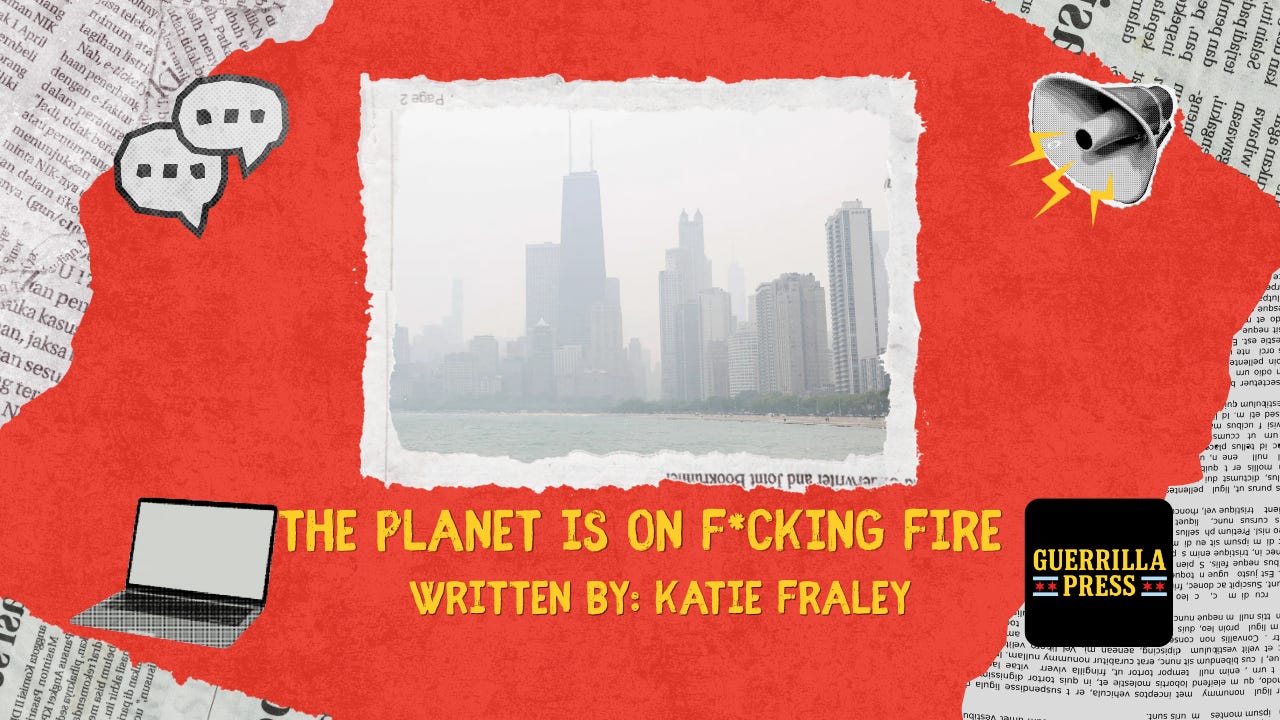
Following the wildfires coming out of Canada in July, smoke made its way into the northern United States, coating cities with dense smog and a sense of dread.
On Thursday, July 16, Chicago had the worst air quality in the world among major cities, which peaked at 747 according to the Air Quality Index (AQI) used by the Environmental Protection Agency. CBS News Chicago even suggested that the AQI here reached 753 that day.
To show you just how unfathomably absurd this score is, I’d like to remind you that the highest number on the standard AQI scale is 500 and any score above 300 is considered hazardous enough to avoid outside activity.
They closed Six Flags for this! They did so with good reason. I’m just salty because it happened to be the day I was supposed to go.
Exposure to those air quality conditions poses significant danger to one’s health. Particulate matter, a primary component of wildfire smoke, increases risk of respiratory distress and can even lead to cardiovascular and neurological issues over time. These particles linger in the air, leaving a threat that clings more strongly to the ecosystem than Mitch McConnell does to life.
These more recent fires around the world are part of a growing example of how natural disasters are worsening at an alarming rate. As temperatures rise and droughts proliferate, drier vegetation helps the fire spread faster and lengthens fire seasons, which are now starting about a month earlier.
There are, of course, many factors that influence wildfire intensity, like foliage density, soil moisture, and infrastructure development. Human-driven influences, however, create some of the most widespread and consequential issues.
Human activities, particularly those causing dryness–much like Republicans do–caused forest fire area to double between 1984 and 2015 in the western U.S., one of the regions in which the increase has been most extreme. The amount of carbon released by wildfires also increased by 60% worldwide between 2001 and 2023.
According to the National Oceanic and Atmospheric Administration (NOAA), the Annual Greenhouse Gas Index (AGGI) rose from 1 to 1.54 between 1990 and 2024. As part of the goal to minimize emissions, the 1990 measurement serves as a baseline for tracking the effect of greenhouse gases produced by human activity. NOAA estimates data back to preindustrial 1750, at which point the AGGI was 0.
To put this into perspective, the AGGI recently increased by 54 percent in just 34 years, whereas it took more than 240 years for the AGGI to rise from 0 to 1, a 100 percent increase, in the first place.
If I have to jingle coins in front of your face like car keys for a baby to get your attention on this, then here goes: In the last 45 years, 24 wildfires in the United States have surpassed $1 billion in damages each, adding up to $213.5 billion across just two dozen fires.
Fire suppression alone costs almost $3 billion annually and is projected to increase by up to 84 percent in the next 25 years. These estimates are breathtaking on their own but are even more so when you consider that these costs only account for suppression efforts and not the cost of wildfire damages.
Future projections also suggest that within the same timeframe, the area burned by these fires could increase by between 42 percent and 306 percent, depending on how our climate changes in this time. There is no point in that range that isn’t absolutely disastrous. Even with the current best-case scenario, we’re–tasteless pun not intended– absolutely cooked.
I don’t know if the people who really need to hear this have a single shred of empathy left to make them care. For those of you who do give the faintest flying fuck about anything besides yourselves, we need to acknowledge that our actions harm more than just humans.
Fires also dispense ash into natural water sources, polluting them and endangering those who rely on them. News flash! That still includes us. Fires damage native plants and animals and can even encourage the spread of invasive species into these areas, further hurting native species. Factoring in lives and homes lost, fires are one of the most devastating disasters.
And we’re actively fueling them.
Wildfires and climate change can seem like a distant issue if you’re not bearing the brunt of the consequences. We take for granted that we don’t get another chance if we ruin this Earth. If we continue down this path of irreparable damage through climate change, future generations won’t get to experience the beautiful Earth that we once knew.
To quote Bill Nye once more: “You’re adults now, and this is an actual crisis. Got it?”
Good.
 | A guest post by
|